Publications
Research in multi-messenger astrophysics
Below is a selection of my papers; the complete record is available on

NASA ADS
and
Google Scholar.
Gaia Sees Blazars Move: Locating Optical Flares Using Astrometry
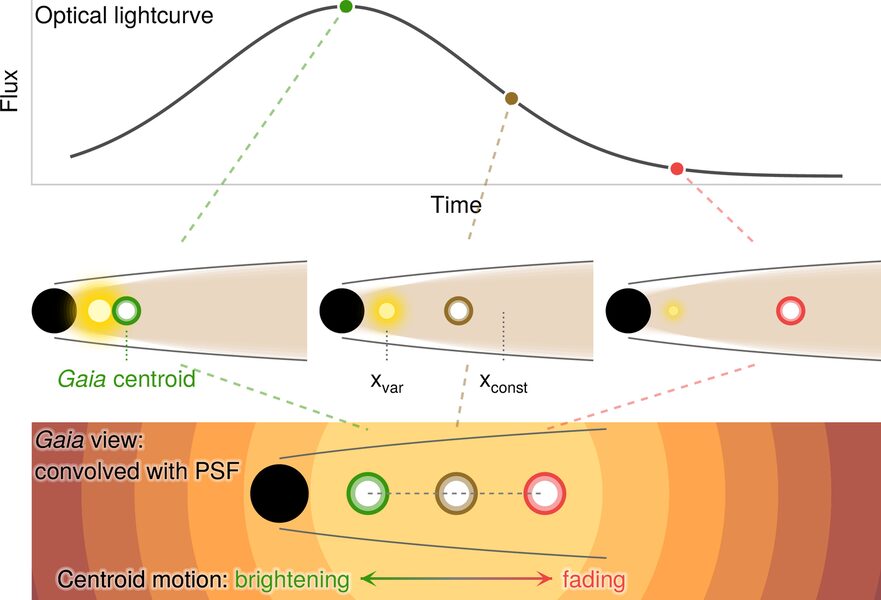
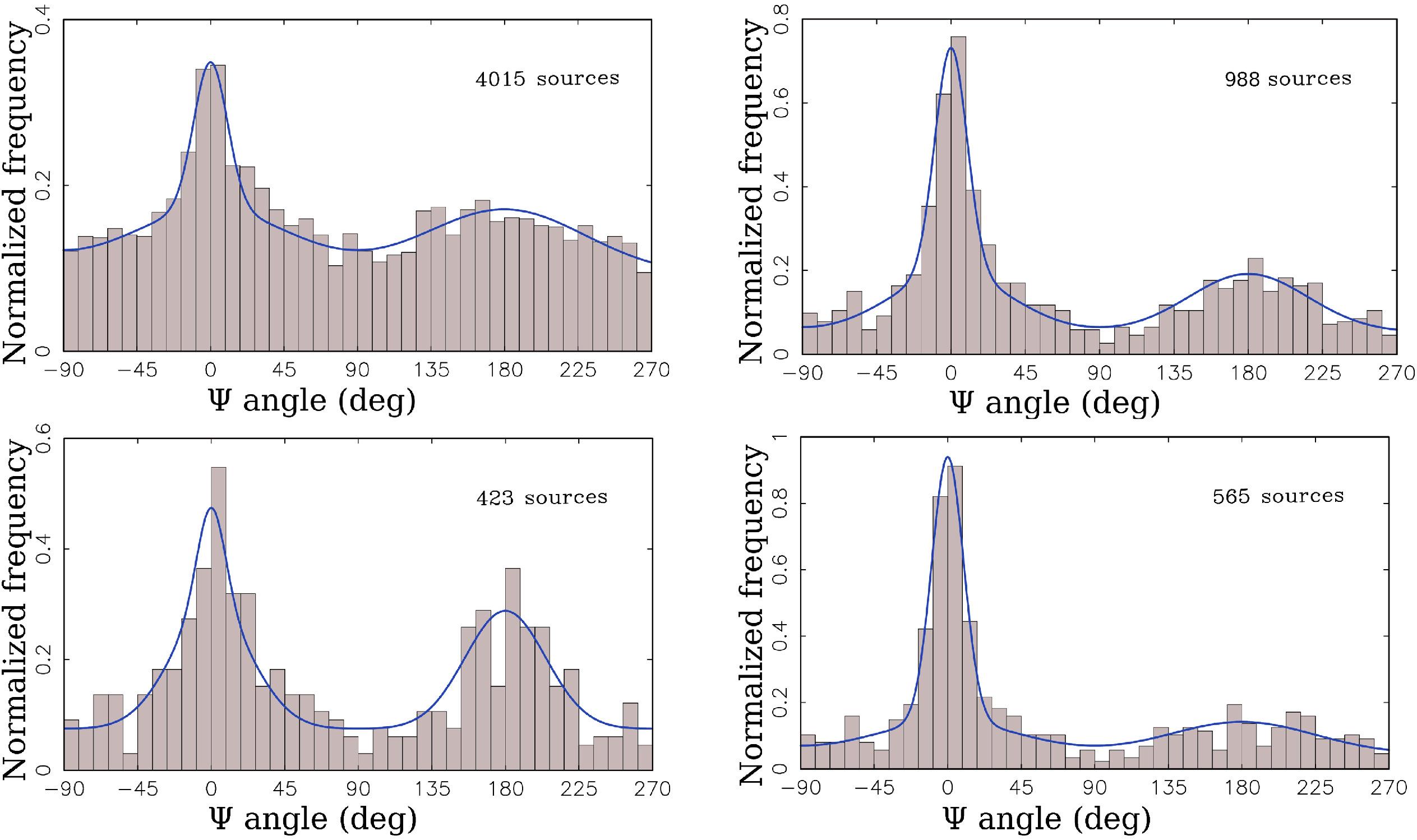
When blazars flare, their optical position moves. We show this by combining Gaia DR3 proper motions with epoch photometry for blazars with strong optical jet emission. In 60 of 74 sources with significant proper motion, rising flux drives the centroid upstream while fading flux drives it downstream—a near-universal pattern captured by a simple two-component model of constant extended emission and a flaring region. Using this connection, we geometrically localize the optical flares to within <1 mas of the very long baseline interferometry position—a few parsecs at typical blazar distances—placing them in the innermost jet or accretion disk. This purely geometric method requires no multiwavelength correlations or model-dependent assumptions. It provides an independent anchor for localizing higher-energy flares and constrains the particle acceleration site in blazars. Per-epoch astrometry from Gaia DR4 is set to tighten our localizations even further.

Parsec-scale polarimetry and kinematics of a spine-sheath jet in the neutrino-blazar TXS 0506+056
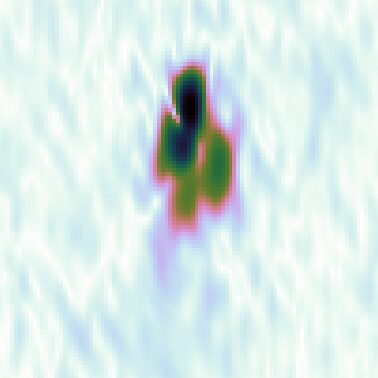
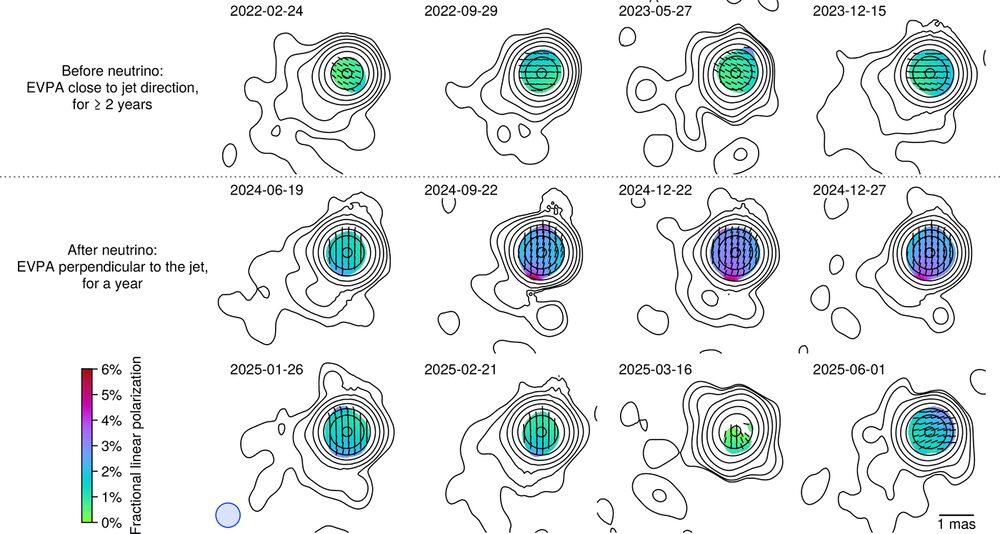
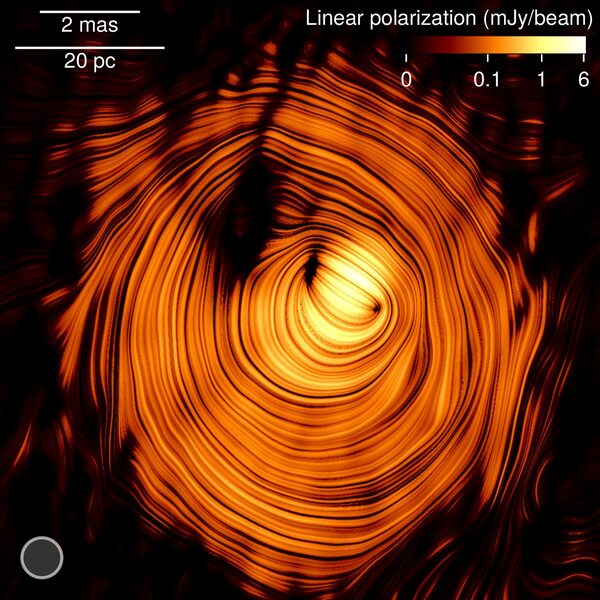
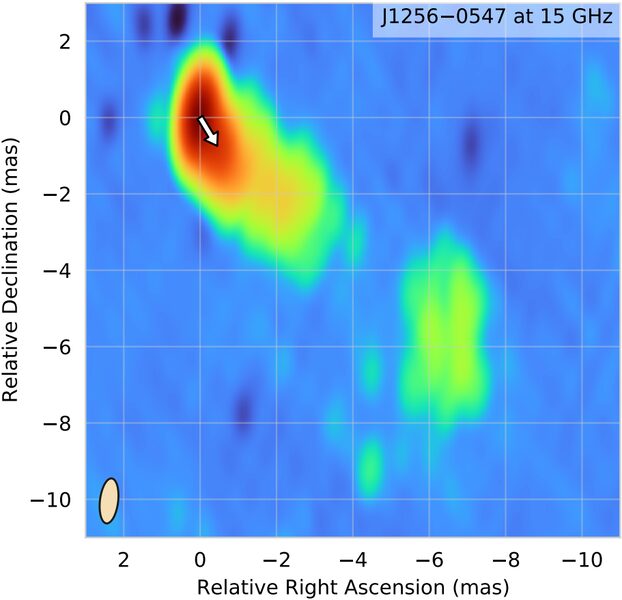
In 2017, the blazar TXS 0506+056 showed a remarkable gamma-ray outburst simultaneously with a high-energy neutrino detection by IceCube from the same sky region. The significance of this association was found to be on the order of 3 sigma thus providing a strong link between the neutrino emission and the blazar flare. The high-energy flare in TXS 0506+056 was followed by a delayed radio flare, peaking in ~2020 in the aftermath of the neutrino event. We investigate the parsec-scale jet structure and dynamics of TXS 0506+056 using 15 GHz full-polarization VLBI observations obtained between 2009 and 2025 with the Very Long Baseline Array. Our kinematic analysis reveals moderate superluminal jet speeds of ~(1-2)c and two quasi-stationary components. A new jet component with comparable speed was ejected contemporaneously with the 2017 IceCube neutrino event. The stacked polarization map is consistent with a stratified spine-sheath jet structure: an inner spine with EVPA aligned with the jet, surrounded by a sheath layer with perpendicular EVPA. Variability in total intensity and polarization further indicates interaction between these layers, particularly evident in characteristic linear polarization flares, associated with EVPA rotations of the quasi-stationary components. The multi-layered jet configuration is consistent with previous studies that were able to explain the neutrino emission in this TXS 0506+056 through a spine-sheath jet structure. We suggest that TXS 0506+056 represents an archetypal case and that similar polarization signatures and geometric light curve flares may be present in other neutrino-emitting sources, potentially offering a solution to the Doppler-crisis phenomenon observed in TeV-emitting blazars.

A hidden ultra-relativistic spine in the jet of a neutrino-associated blazar
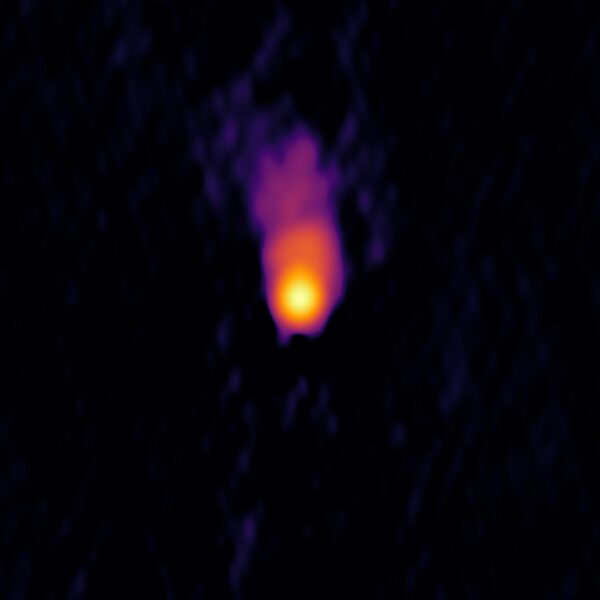
Supermassive black holes launch powerful jets of plasma that can accelerate particles to extreme energies, but the physical conditions required to produce high-energy neutrinos remain unknown. In the blazar TXS 0506+056, the first source individually linked to a high-energy neutrino, radio images had seemed to reveal a jet too slow to sustain the extreme conditions required for neutrino production. Here we resolve this tension using long-term radio monitoring, particularly Very Long Baseline Interferometry (VLBI) imaging. We uncover a disturbance in emission propagating with an apparent speed of 21+-1 times the speed of light, that is masked by slower, radio-bright features that dominated earlier analyses. We interpret this as the signature of a stratified jet: an ultra-relativistic spine with Lorentz factor Gamma>20 embedded within a slower outer sheath. As the disturbance travels along the spine, it progressively illuminates the sheath, producing the delayed radio flare and naturally accounting for the years-long offset between neutrino and radio emission. The same pattern recurs in a second neutrino-associated event, pointing to a repeatable multi-messenger engine. These findings challenge the standard interpretation of VLBI jet speeds and establish a concrete, testable framework connecting structured jets to the sources of the Universe's highest-energy neutrinos.

Unique Science Opportunities for Space VLBI Systems with the SKA Telescopes
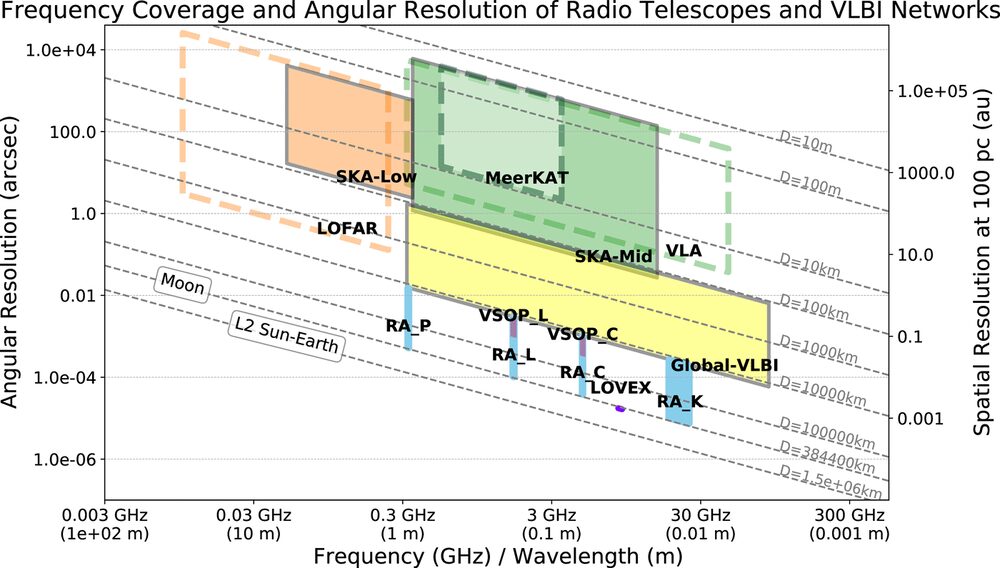
To date, two dedicated Space Very Long Baseline Interferometry (SVLBI) missions, the VLBI Space Observatory Programme (VSOP) and RadioAstron, have provided groundbreaking insights into the Universe at angular resolutions as fine as ~10 microarcseconds. The phased SKA-Mid, with its exceptional sensitivity and broad frequency coverage, will form a unique ground-based anchor for future SVLBI missions, driving major advances into previously unexplored regions of the angular resolution-sensitivity parameter space. The discovery of extreme brightness temperatures in blazars by RadioAstron demands detailed investigation with next-generation SVLBI. Such studies are crucial for understanding particle (re-)acceleration mechanisms, with direct implications for the search for high-energy neutrino sources. Combining centimeter-wavelength SVLBI with millimeter ground-based VLBI at comparable resolutions will enable detailed studies of plasma stratification and instabilities in Active Galactic Nuclei (AGN) jets, as well as the processes of jet formation, acceleration, collimation, and magnetic field evolution, for example through Faraday rotation mapping. The unprecedented sensitivity of the SKA-Mid will allow observations of active galactic nuclei to very high redshifts, tracing their evolution and overcoming opacity caused by the (1+z) shift of intrinsic emission frequencies. Future centimeter SVLBI experiments will also probe scattering in the interstellar medium through pulsar, maser, and AGN observations. Finally, the combination of multiple tied-array beams from the SKA telescopes and the extremely long SVLBI baselines will enable ultra-precise astrometry using the next-generation MultiView technique, allowing measurements of extragalactic parallaxes of pulsars and megamasers, proper motions of supermassive black holes, and even the astrometric detection of exoplanets.

Revisiting the angular size–redshift cosmological test with milliarcsecond radio structures in active galactic nuclei
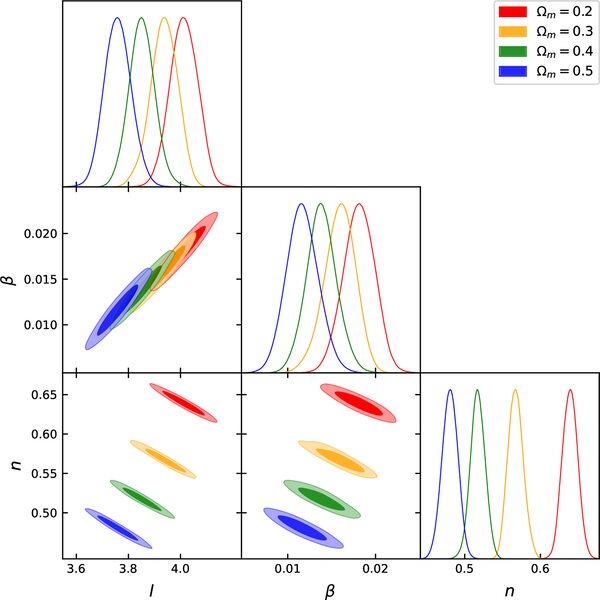
Context. Very long baseline interferometry (VLBI) measurements of the sizes of compact extragalactic radio sources, jetted active galactic nuclei, provide data for probing the angular size–redshift relation, offering a classical cosmological test complementary to other distance–redshift methods. Aims. Aiming to update and extend previous studies conducted in the 1990s, we analyse a significantly expanded and improved dataset to reassess the angular size–redshift relation and its potential for constraining cosmological model parameters, focusing on the matter density parameter, Ωm, in a flat Λ cold dark matter Universe. This is the first major update of the compact-source angular size test in the past quarter of a century, using a dataset an order of magnitude larger than in previous studies. Methods. We performed a Markov chain Monte Carlo analysis on real data and on multiple mock catalogues with varying Gaussian noise levels (10%,20%,50%) to evaluate parameter constraints in the presence of observational scatter. In addition, we conducted a test with 100 randomized catalogues created by shuffling redshifts while preserving other observables to explore the statistical significance of the angular size–redshift dependence. We also explored how astrophysical parameters depend on fixed cosmological models with different Ωm values. Results. The randomization test showed that the posterior distributions from randomized data do not overlap with those from real observations, with significant deviations, confirming that the measured angular size–redshift relation is physically meaningful and not a chance alignment. The astrophysical model parameter that describes the redshift dependence of the source angular size exhibits strong sensitivity and degeneracy with Ωm. Simulated mock catalogues indicate that the method is able to constrain Ωm if the data scatter is below ∼20%, but current real data noise levels are too high for reaching competitive cosmological constraints. Scaling estimates suggest that high-quality data of samples of several thousands to ∼100 000 sources, a standardization calibration approach, and/or refining sample selection criteria are needed to fully exploit the potential of the angular size–redshift test with this type of object.

Heavy interstellar scattering toward the near end of the Galactic bar
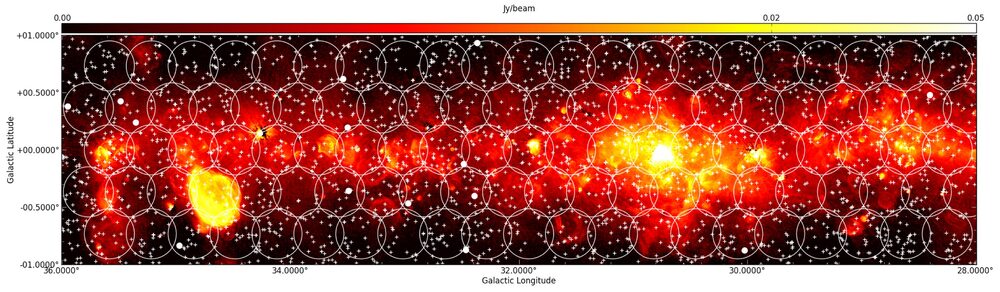
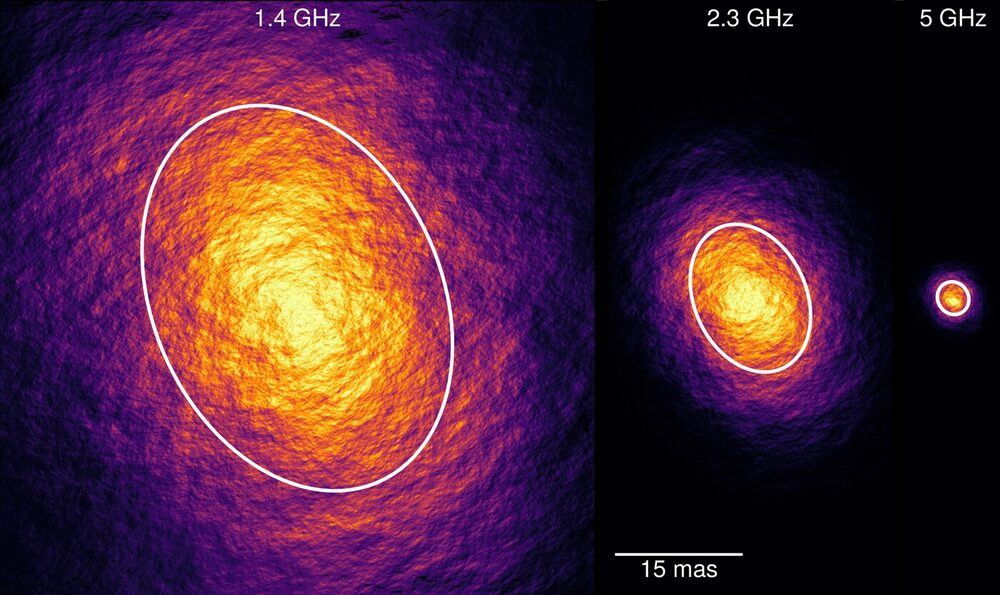
We present results of a pilot observational wide-field VLBI (very long baseline interferometry) campaign on probing scattering properties of the partly ionized interstellar medium towards the Galactic plane sky region between 28° < l < 36° and |b| < 1°. This covers the region where the Galactic bar connects to the spiral arms and where a lot of star formation is currently ongoing. The VLBA (Very Long Baseline Array) observations of the whole region were performed in a special mode with multiple phase centres at Lband (1.4–1.8 GHz) during 2022 April–June, and a year later, complemented by sessions at S band (2.2–2.4 GHz) and C band (4.6–5.0 GHz) partially covering the pilot region. We found compelling evidence that target sources are subject to scattering. The total detection rate in L, S, and C bands is 1.5, 3.4, and 9.2 per cent, respectively, and approximately scales with the square of the observation frequency. The low rate values imply that scattering is strong. Its power is non-uniform across the Galactic plane, and it can be approximated by a Gaussian with a width of about 2° peaking at the Galactic mid-plane. One of the brightest sources of the field shows anisotropic scattering, with a λ2 dependence of its observed angular size, along a position angle of 26° aligned with the line of constant Galactic latitude. We estimate the turbulence dissipation scale rin ≈ 1500 km towards the source J1833+0015.

Direct Very Long Baseline Interferometry Detection of Interstellar Turbulence Imprint on a Quasar: TXS 2005+403
We report the first unambiguous detection of refractive substructure in an active galactic nucleus (AGN) using ground-based very long baseline interferometry (VLBI). Our analysis of TXS 2005+403—observed at 1–5 GHz along a line of sight through the Cygnus region—reveals clear signatures of turbulence-induced substructure on long baselines that cannot be explained by the smooth scatter-broadened profile from diffractive effects alone. This signal persists across multiple observations spanning 2010–2019, demonstrating stable scattering properties along this line of sight. The combination of high flux density, compact intrinsic structure, and strong scattering establishes TXS 2005+403 as an exceptional laboratory for probing Galactic turbulence. This detection demonstrates that AGNs can serve as cosmic lighthouses illuminating interstellar plasma across the sky, complementing pulsar scintillation studies and informing scattering mitigation for millimeter-wavelength imaging of Sagittarius A*.

Multimessenger flare in the quasar PKS 0446+11
Context. The physical mechanisms driving neutrino and electromagnetic flares in blazars remain poorly understood. Aims. We investigate a prominent multimessenger flare in the quasar PKS 0446+11 to identify the processes responsible for its high-energy emission. Methods. We analyzed the IceCube-240105A high-energy neutrino event together with contemporaneous observations in the gamma-ray, X-ray, optical, and radio bands. We modeled the on- and off-flare spectral energy distributions (SEDs) within a single-zone leptohadronic framework. Multi-epoch VLBA observations from the MOJAVE program provide parsec-scale polarization data that complement the multiwavelength light curves. Results. No significant time delay was detected between the neutrino arrival and the flares in different energy bands. This is consistent with an extremely small jet viewing angle below 1 deg, inferred from the parsec-scale polarization structure. The flare can be reproduced by the injection of a proton population and an increase in the Doppler factor from 18 to 24. We also detected an approximately 90 deg rotation of the EVPA in the parsec-scale core during the initial phase of the flare, indicating the emergence of a shock formed by the change in the bulk plasma speed. Conclusions. Our comprehensive multimessenger analysis demonstrates that the extreme beaming and subdegree viewing angle of this distant blazar can account for the observed neutrino and electromagnetic activity. These findings strengthen the case for blazars as efficient accelerators of hadrons and significant contributors to the observed high-energy neutrino flux.

Radio Structure of Active Galactic Nuclei on the RATAN-600 and CATS Data at Frequencies 0.01–500 GHz
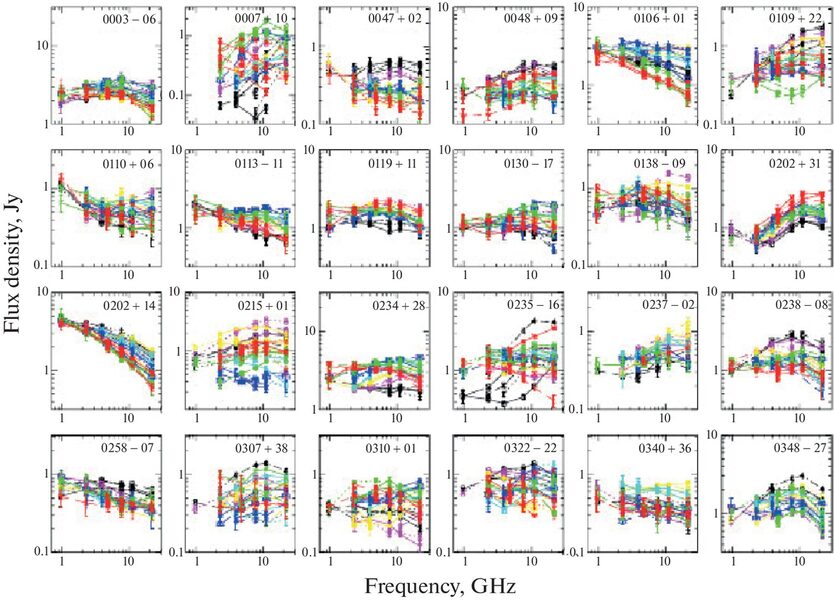
Monitoring of 1–22 GHz spectra of blasars at the radio telescope RATAN-600 and their modeling using the known CATS data base are continued. The ''Hedgehog'' model proposed by N.S. Kardashev in 1969 and successfully applied later to explain variable spectra is used. For 13 objects modeled by relativistic proton jets, the main physical parameters were estimated. In 4 of them, new compact components in active nuclei may be detected. Accelerated protons may be high energy neutrino sources.

Constraints on the diffuse flux of multi-PeV astrophysical neutrinos obtained with the Baikal Gigaton Volume Detector
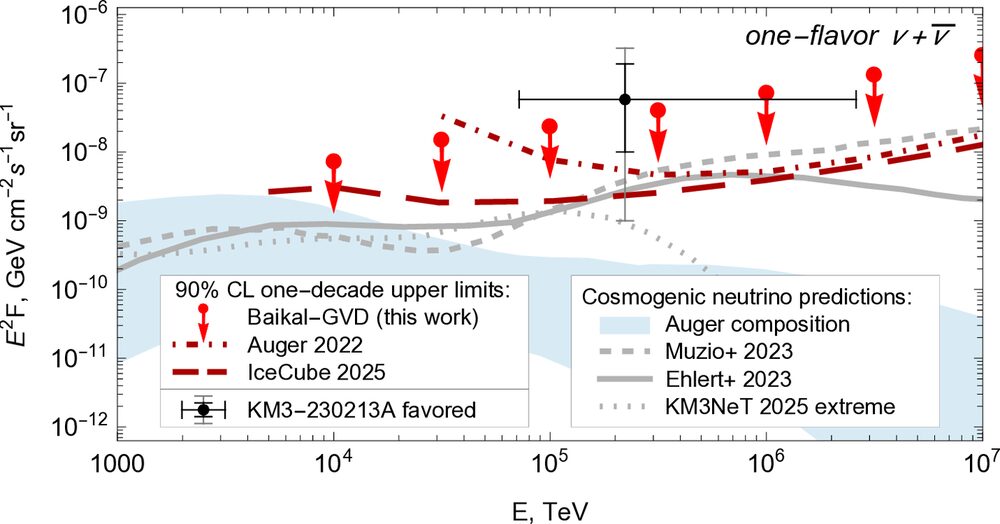
Various theoretical models predict cosmic neutrinos with multi-PeV energies. The recent detection of a ∼1017 eV neutrino in the KM3NeT experiment suggests that these energetic particles can be studied with present-day installations. Here, we present upper limits on the flux of astrophysical neutrinos with energies (1015.5–1020) eV obtained with the largest liquid-water neutrino telescope, the Baikal Gigaton Volume Detector (GVD), operation using cascadelike events. We discuss astrophysical implications of these results and constrain several cosmogenic neutrino scenarios using a combination of Baikal-GVD, KM3NeT, IceCube, and Auger data.

Dim cores of radio-bright AGN jets: VLBI and Gaia astrometry pinpoint different parsec-scale features
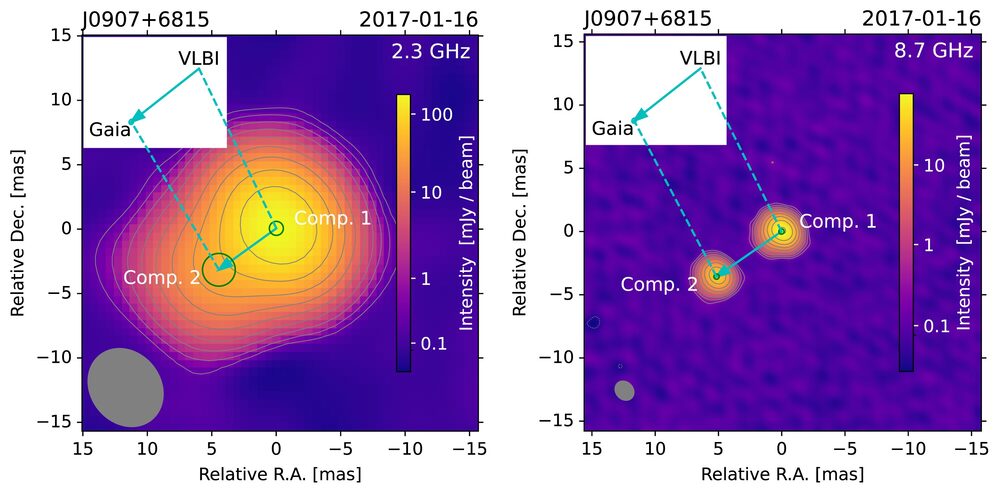
Astrometry with the very long baseline radio interferometry (VLBI) allows to determine the position of a point close to the source's brightest compact detail at milliarcsecond scales. For most active galactic nuclei (AGNs), this compact detail is the opaque core of the radio jet. Rare cases of sources whose brightest detail is not the core but a prominent jet feature parsecs away from the core have been reported, but such sources remained elusive. In this work, we use a novel method for a systematic search of these sources. We scrutinize the AGNs for which the offset between their coordinates determined with VLBI and Gaia is statistically significant and coincides with the vector between two dominant features in their VLBI images, using publicly available archival multifrequency data. We find 35 sources whose VLBI coordinates are associated with a bright component of their jet separated by several to tens of mas from the radio core. Their Gaia coordinates, in turn, correspond to the jet origin close to the radio jet core. The previously published jet directions of most of them must be reversed. These sources exhibit atypically low brightness temperatures of the radio cores, down to 109 K in the host galaxy frame, and, at the same time, extreme brightness of the dominating jet components. We argue that these bright components are standing shock fronts and discuss possible physical explanations for the low core brightness, such as ineffective particle heating, atypical absorption, or differential Doppler boosting.

Extreme Jet Beaming Observed in Neutrino-associated Blazars
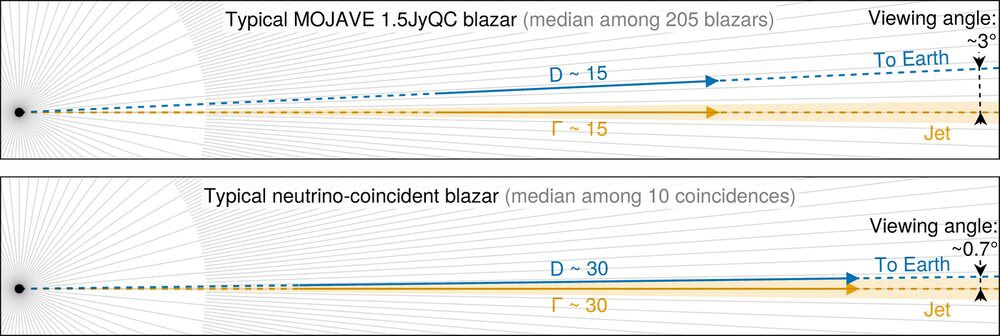
Bright blazars were found to be prominent neutrino sources, and a number of IceCube events were associated with them over recent years. A particularly strong observational connection is present between neutrinos and blazars with bright, Doppler-boosted, parsec-scale radio emission. In this work, we further explore the nature of this connection by examining the jet geometry and kinematics of neutrino-associated blazars. We find that these blazars demonstrate remarkably strong jet beaming, even compared to other radio-bright sources. Their Doppler and Lorentz factors are larger, and viewing angles are smaller than for other blazars in the complete uniformly selected MOJAVE sample. Observationally, this serves as yet another piece of evidence for blazars forming a major population of neutrino sources. The strong neutrino–beaming correlation indicates that high-energy neutrino velocity is predominantly oriented along the jet, and the original PeV-scale protons exhibit a relativistic bulk motion along the jet. It suggests that neutrino production happens not too close to the black hole, but rather at subparsec distances, where the jet is already accelerated.

Looking into the jet cone of the neutrino-associated very high-energy blazar PKS 1424+240
Context. The acceleration process of massive particles as well as the production of very high-energy (VHE) photons and neutrinos remains a fundamental challenge in astrophysics. Aims. We investigate the parsec-scale jet structure and magnetic field of the blazar PKS 1424+240, which was selected on the basis of strong VHE gamma-ray emission and is identified with one of the highest peaks in the IceCube 9-year neutrino sky. Methods. We analyzed 15 GHz VLBA observations of this BL Lac object by stacking 42 polarization-sensitive images collected in 2009–2025 to enhance the signal and reveal the persistent parsec-scale structure. Results. Our observations uncover a rare scenario. The object is viewed inside the jet cone, very close to the axis of its relativistic jet, with a viewing angle of < 0.6°. This effectively maximizes Doppler boosting to values ∼30 and enhances the electromagnetic and neutrino emission in the direction of the observer. Based on polarimetric observations, we unambiguously detect a net toroidal component in the magnetic field of the jet. This indicates a current-carrying jet that flows almost directly toward our line of sight. Conclusions. Blazars with very small jet viewing angles offer a solution to the Doppler factor crisis, i.e., to the longstanding mismatch between Doppler factors inferred from the low apparent jet speed in very long-baseline interferometry and those derived from VHE observations. We show that relativistic beaming plays the critical role in the gamma-ray and neutrino emission of blazars. This has direct implications for models of their multimessenger emission.

Probing the Galactic Neutrino Flux at Neutrino Energies above 200 TeV with the Baikal Gigaton Volume Detector
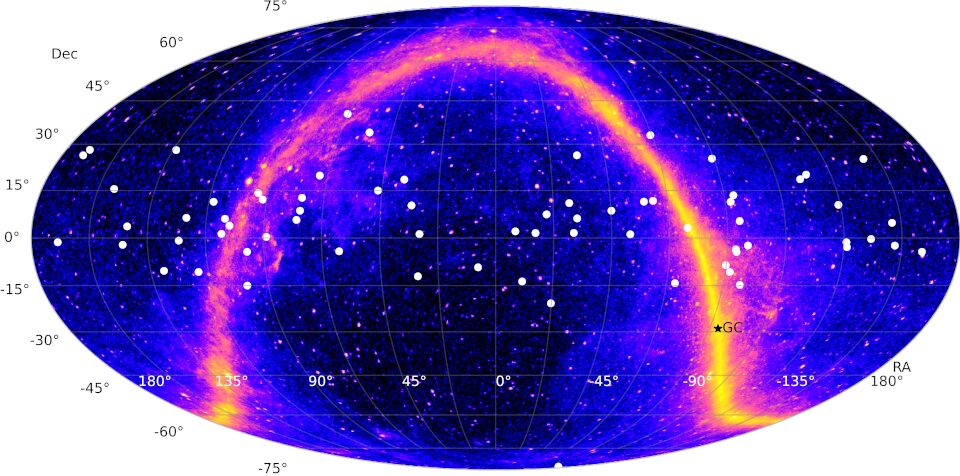
Recent observations of the Galactic component of the high-energy neutrino flux, together with the detection of the diffuse Galactic gamma-ray emission up to sub-PeV energies, open new possibilities to study the acceleration and propagation of cosmic rays in the Milky Way. At the same time, both large nonastrophysical backgrounds at TeV energies and the scarcity of neutrino events in the sub-PeV band currently limit these analyses. Here, we use the sample of cascade events with estimated neutrino energies above 200 TeV, detected by the partially deployed Baikal Gigaton Volume Detector (GVD) in 6 yr of operation, to test the continuation of the Galactic neutrino spectrum to sub-PeV energies. We find that the distribution of the arrival directions of Baikal-GVD cascades above 200 TeV in the sky suggests an excess of neutrinos from low Galactic latitudes with the chance probability of 1.4 × 10⁻². We also find the excess above 200 TeV in the most recent IceCube public data sets, both of cascades and tracks. The chance probability of the excess in the combined IceCube and Baikal-GVD analysis is 3.4 × 10⁻⁴. The flux of Galactic neutrinos above 200 TeV challenges often-used templates for neutrino search based on cosmic-ray simulations.

Evolution of parsec-scale jet directions in active galaxies
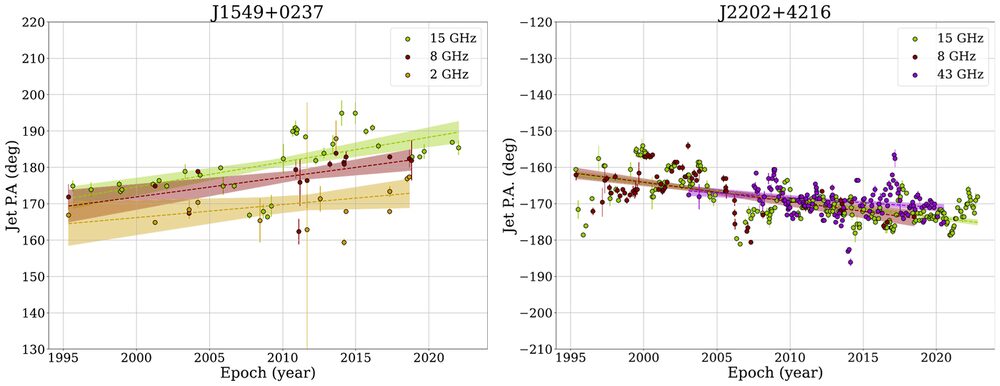
We analyse the variability of the parsec-scale jet directions in active galactic nuclei (AGNs). Our analysis involves 317 AGNs at frequencies ranging from 2 to 43 GHz, and is made possible by developing an automatic jet direction measurement procedure. We find strong significant variations in a one quarter of these AGNs; the effect is likely ubiquitous, and not detected in the rest due to a limited sensitivity and observations epoch coverage. Apparent jet rotation speeds range from 0.21 deg yr-1 at 2 GHz to 1.04 deg yr-1 at 43 GHz. This strong frequency dependence indicates that the variability cannot be explained by jet components propagating ballistically without acceleration: more complex jet shapes or motion patterns are required. Still, we demonstrate that the apparent direction changes are predominantly caused by the jet nozzle rotations, and not by individual components propagating transversely to the jet. In this work, we focus on variability scales much longer than the times of observations, that is ≳ 50 yr. Using our measurements, we bound potential periods to less than 1000 yr in the source rest frame for 90 per cent AGNs in the sample. These time-scales constrain jet direction variation mechanisms, with the most likely explanations being the plasma instabilities, the precession caused by the accretion disc with density ~r-1, and the orbital motion of binary systems.

Two bright blazars located close to the IceCube-241224A neutrino are found to flare in radio band
IceCube collaboration has recently detected a neutrino event IceCube-241224A, which has two blazars with bright and compact parsec-scale jets close to its arrival direction.
The SARAO MeerKAT 1.3 GHz Galactic Plane Survey
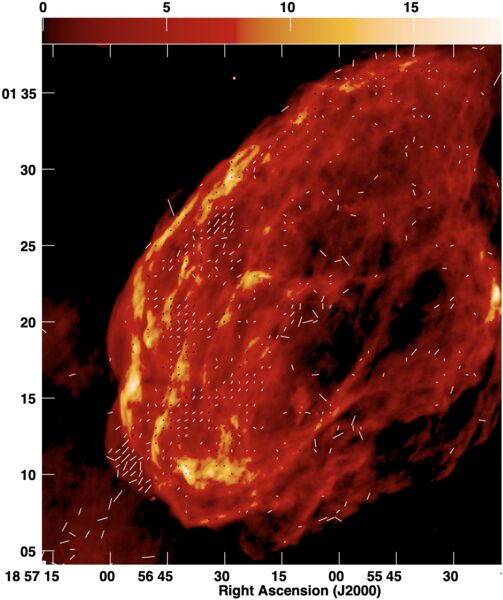
We present the SARAO MeerKAT Galactic Plane Survey (SMGPS), a 1.3 GHz continuum survey of almost half of the Galactic Plane (251° ≤l ≤ 358° and 2° ≤l ≤ 61° at |b| ≤ 1°.5). SMGPS is the largest, most sensitive, and highest angular resolution 1 GHz survey of the plane yet carried out, with an angular resolution of 8 arcsec and a broad-band root-mean-square sensitivity of ~10-20 μJy beam-1. Here, we describe the first publicly available data release from SMGPS which comprises data cubes of frequency-resolved images over 908-1656 MHz, power-law fits to the images, and broad-band zeroth moment integrated intensity images. A thorough assessment of the data quality and guidance for future usage of the data products are given. Finally, we discuss the tremendous potential of SMGPS by showcasing highlights of the Galactic and extragalactic science that it permits. These highlights include the discovery of a new population of non-thermal radio filaments; identification of new candidate supernova remnants, pulsar wind nebulae and planetary nebulae; improved radio/mid-infrared classification of rare luminous blue variables and discovery of associated extended radio nebulae; new radio stars identified by Bayesian cross-matching techniques; the realization that many of the largest radio-quiet Wide-field Infrared Survey Explorer (WISE) H II region candidates are not true H II regions; and a large sample of previously undiscovered background H I galaxies in the Zone of Avoidance.

Hard X-ray emission from blazars associated with high-energy neutrinos
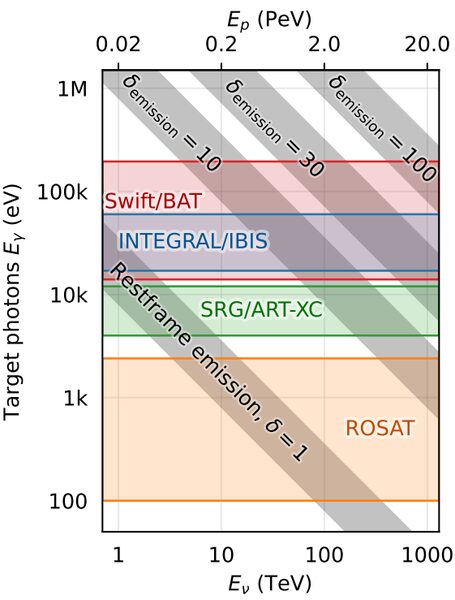
Bright blazars were found to be prominent neutrino sources, and a number of IceCube events were associated with them. Evaluating high-energy photon emission of such blazars is crucial for better understanding of the processes and regions where neutrinos are produced. Here, we focus on hard X-ray emission observed by the SRG/ART-XC telescope, by the Swift/BAT imager, and by the INTEGRAL/IBIS telescope. Their energy range ≳10 keV is well-suited for probing photons that potentially participate in neutrino production by interacting with ultrarelativistic protons. We find that neutrino-associated blazars tend to demonstrate remarkably strong X-ray emission compared to other VLBI blazars in the sky. Both neutrinos and hard X-rays are found to come from blazars at cosmological distances z ∼ 1, and are boosted by relativistic beaming that makes it possible to detect them on Earth. Our results suggest that neutrinos are produced within compact blazar jets, with target X-ray photons emitted from accelerated jet regions.

Searches for Neutrinos in the Direction of Radio-bright Blazars with the ANTARES Telescope
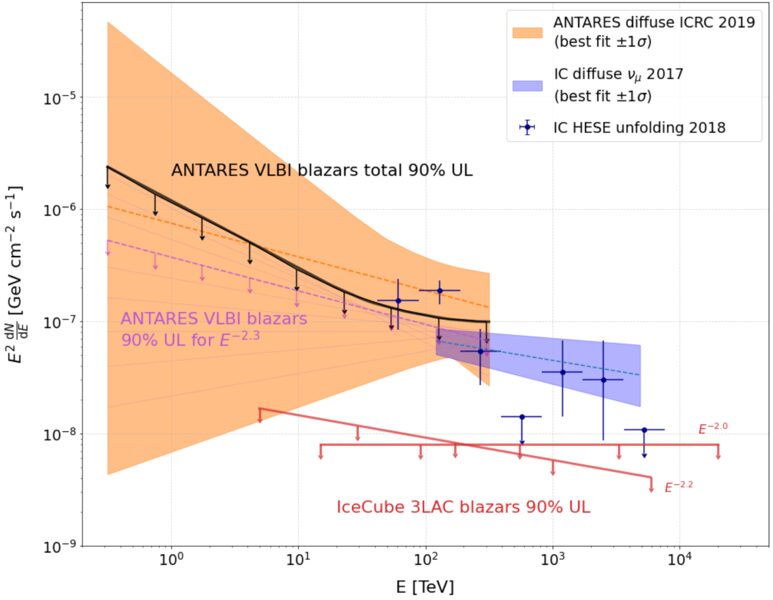
Active galaxies, especially blazars, are among the most promising extragalactic candidates for high-energy neutrino sources. To date, ANTARES searches included these objects and used GeV–TeV γ-ray flux to select blazars. Here, a statistically complete blazar sample selected by their bright radio emission is used as the target for searches of origins of neutrinos collected by the ANTARES neutrino telescope over 13 yr of operation. The hypothesis of a neutrino–blazar directional correlation is tested by pair counting and a complementary likelihood-based approach. The resulting posttrial p-value is 3.0% (2.2σ in the two-sided convention). Additionally, a time-dependent analysis is performed to search for temporal clustering of neutrino candidates as a means of detecting neutrino flares in blazars. None of the investigated sources alone reaches a significant flare detection level. However, the presence of 18 sources with a pretrial significance above 3σ indicates a p = 1.4% (2.5σ in the two-sided convention) detection of a time-variable neutrino flux. An a posteriori investigation reveals an intriguing temporal coincidence of neutrino, radio, and γ-ray flares of the J0242+1101 blazar at a p = 0.5% (2.9σ in the two-sided convention) level. Altogether, the results presented here suggest a possible connection of neutrino candidates detected by the ANTARES telescope with radio-bright blazars.

Radio-flaring blazar PKS 0446+11 with bright parsec-scale core as a candidate for IceCube-240105A: RATAN-600 and MOJAVE VLBA observations
A radio-loud high redshift (z=2.153) blazar PKS 0446+11 was indicated as a likely source candidate for the recent high-energy neutrino event IceCube-240105A (GCN#35485, GCN#35498).
High-energy neutrino-induced cascade from the direction of the flaring radio blazar TXS 0506 + 056 observed by Baikal-GVD in 2021
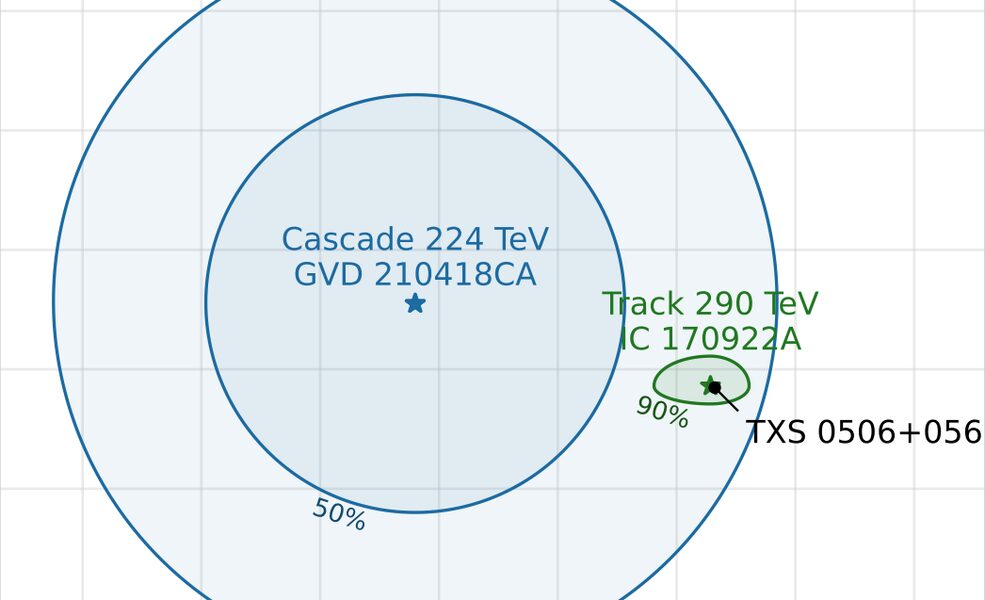
The existence of high-energy astrophysical neutrinos has been unambiguously demonstrated, but their sources remain elusive. IceCube reported an association of a 290-TeV neutrino with a gamma-ray flare of TXS 0506 + 056, an active galactic nucleus with a compact radio jet pointing to us. Later, radio-bright blazars were shown to be associated with IceCube neutrino events with high statistical significance. These associations remained unconfirmed with the data of independent experiments. Here, we report on the detection of a rare neutrino event with the estimated energy of 224 ± 75 TeV from the direction of TXS 0506 + 056 by the new Baikal Gigaton Volume Detector (Baikal-GVD) in April 2021. This event is the highest energy cascade detected so far by the Baikal-GVD neutrino telescope from a direction below horizon. The result supports previous suggestions that radio blazars in general, and TXS 0506 + 056 in particular, are the sources of high-energy neutrinos, and opens up the cascade channel for the neutrino astronomy.

Search for directional associations between baikal gigaton volume detector neutrino-induced cascades and high-energy astrophysical sources
Baikal-GVD has recently published its first measurement of the diffuse astrophysical neutrino flux, performed using high-energy cascade-like events. We further explore the Baikal-GVD cascade data set collected in 2018-2022, with the aim to identify possible associations between the Baikal-GVD neutrinos and known astrophysical sources. We leverage the relatively high angular resolution of the Baikal-GVD neutrino telescope (2-3 deg.), made possible by the use of liquid water as the detection medium, enabling the study of astrophysical point sources even with cascade events. We estimate the telescope's sensitivity in the cascade channel for high-energy astrophysical sources and refine our analysis prescriptions using Monte-Carlo simulations. We primarily focus on cascades with energies exceeding 100 TeV, which we employ to search for correlation with radio-bright blazars. Although the currently limited neutrino sample size provides no statistically significant effects, our analysis suggests a number of possible associations with both extragalactic and Galactic sources. Specifically, we present an analysis of an observed triplet of neutrino candidate events in the Galactic plane, focusing on its potential connection with certain Galactic sources, and discuss the coincidence of cascades with several bright and flaring blazars.

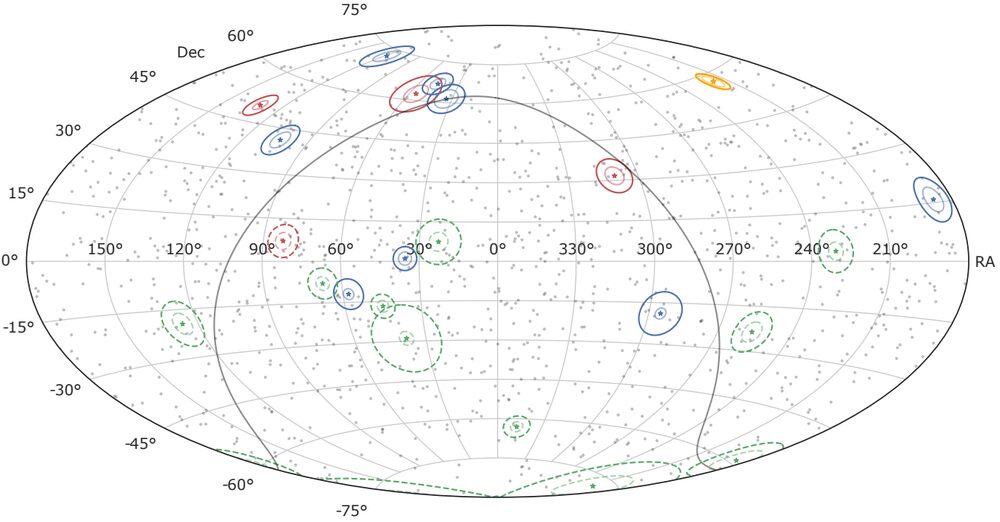
Growing evidence for high-energy neutrinos originating in radio blazars
Evidence for bright-radio blazars being high-energy neutrino sources was found in recent years. However, specifics of how and where these particles get produced still need to be determined. In this paper, we add 14 new IceCube events from 2020-2022 to update our analysis of the neutrino-blazars connection. We test and refine earlier findings by utilizing the total of 71 track-like high-energy IceCube events from 2009-2022. We correlate them with the complete sample of 3412 extragalactic radio sources selected by their compact radio emission. We demonstrate that neutrinos are statistically associated with radio-bright blazars with a post-trial p-value of 3 · 10-4. In addition to this statistical study, we confirm previous individual neutrino-blazar associations, find and discuss several new ones. Notably, PKS 1741 - 038 was selected earlier and had a second neutrino detected from its direction in 2022; PKS 0735 + 168 has experienced a major flare across the whole electromagnetic spectrum coincidently with a neutrino arrival from that direction in 2021.

RadioAstron discovery of a mini-cocoon around the restarted parsec-scale jet in 3C 84
We present RadioAstron space-based very long baseline interferometry (VLBI) observations of the nearby radio galaxy 3C 84 (NGC 1275) at the centre of the Perseus cluster. The observations were carried out during a perigee passage of the Spektr-R spacecraft on September 21-22, 2013 and involved a global array of 24 ground radio telescopes observing at 5 GHz and 22 GHz, together with the Space Radio Telescope (SRT). Furthermore, the Very Long Baseline Array (VLBA) and the phased Very Large Array (VLA) observed the source quasi-simultaneously at 15 GHz and 43 GHz. Fringes between the ground array and the SRT were detected on baseline lengths up to 8.1 times the Earth's diameter, providing unprecedented resolution for 3C 84 at these wavelengths. We note that the corresponding fringe spacing is 125 μas at 5 GHz and 27 μas at 22 GHz. Our space-VLBI images reveal a previously unseen sub-structure inside the compact ∼1 pc long jet that was ejected about ten years earlier. In the 5 GHz image, we detected, for the first time, low-intensity emission from a cocoon-like structure around the restarted jet. Our results suggest that the increased power of the young jet is inflating a bubble of hot plasma as it carves its way through the ambient medium of the central region of the galaxy. Here, we estimate the minimum energy stored in the mini-cocoon, along with its pressure, volume, expansion speed, and the ratio of heavy particles to relativistic electrons, as well as the density of the ambient medium. About half of the energy delivered by the jet is dumped into the mini-cocoon and the quasi-spherical shape of the bubble suggests that this energy may be transferred to a significantly larger volume of the interstellar medium than what would be accomplished by the well-collimated jet on its own. The pressure of the hot mini-cocoon also provides a natural explanation for the almost cylindrical jet profile seen in the 22 GHz RadioAstron image. The final maps are only available at the CDS via anonymous ftp to cdsarc.cds.unistra.fr (ftp://130.79.128.5) or via https://cdsarc.cds.unistra.fr/viz-bin/cat/J/A+A/676/A114

Probing Neutrino Production in Blazars by Millimeter VLBI
The advancement of neutrino observatories has sparked a surge in multi-messenger astronomy. Multiple neutrino associations among blazars are reported while neutrino production sites are located within their central (sub)parsecs. Yet, many questions remain on the nature of those processes. The next generation Event Horizon Telescope (ngEHT) is uniquely positioned for these studies, as its high frequency and resolution can probe both the accretion disk region and the parsec-scale jet. This opens up new opportunities for connecting the two regions and unraveling the proton acceleration and neutrino production in blazars. We outline observational strategies for ngEHT and highlight what it can contribute to the multi-messenger study of blazars.

Galactic Contribution to the High-energy Neutrino Flux Found in Track-like IceCube Events
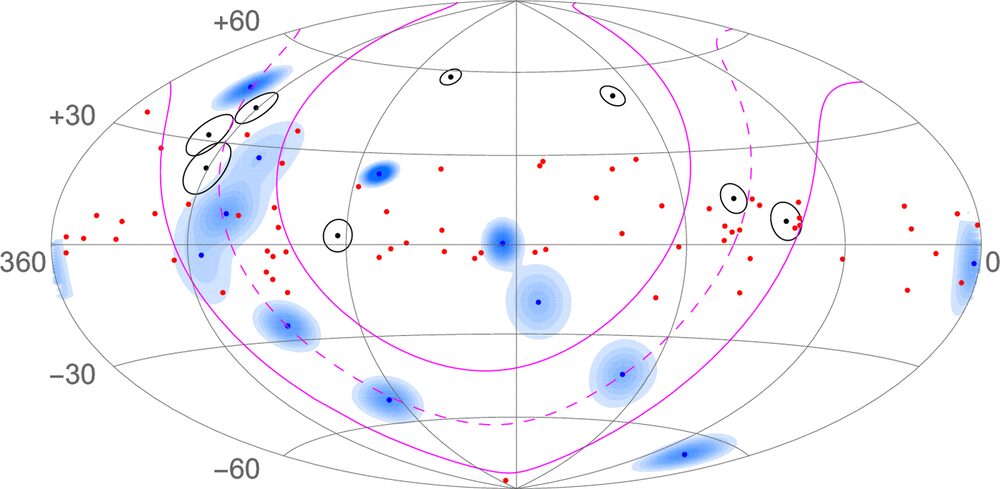
Astrophysical sources of neutrinos detected by large-scale neutrino telescopes remain uncertain. While there exist statistically significant observational indications that a part of the neutrino flux is produced by blazars, numerous theoretical studies suggest also the presence of potential Galactic point sources. Some of them have been observed in gamma rays above 100 TeV. Moreover, cosmic-ray interactions in the Galactic disk guarantee a diffuse neutrino flux. However, these Galactic neutrinos have not been unambiguously detected so far. Here we examine whether such a Galactic component is present among the observed neutrinos of the highest energies. We analyze public track-like IceCube events with estimated neutrino energies above 200 TeV. We examine the distribution of arrival directions of these neutrinos in the Galactic latitude b with the help of a simple unbinned, nonparametric test statistics, the median ∣b∣ over the sample. This distribution deviates from that implied by the null hypothesis of the neutrino flux isotropy, and is shifted toward lower ∣b∣ with the p-value of 4 × 10⁻⁵, corresponding to the statistical significance of 4.1σ. There exists a significant component of the high-energy neutrino flux of Galactic origin, matching well the multimessenger expectations from Tibet-ASγ observations of diffuse Galactic gamma rays at hundreds of TeV. Together with the previously established extragalactic associations, the Galactic component we report here implies that the neutrino sky is rich and is composed of contributions from various classes of sources.

Tracing Milky Way scattering by compact extragalactic radio sources
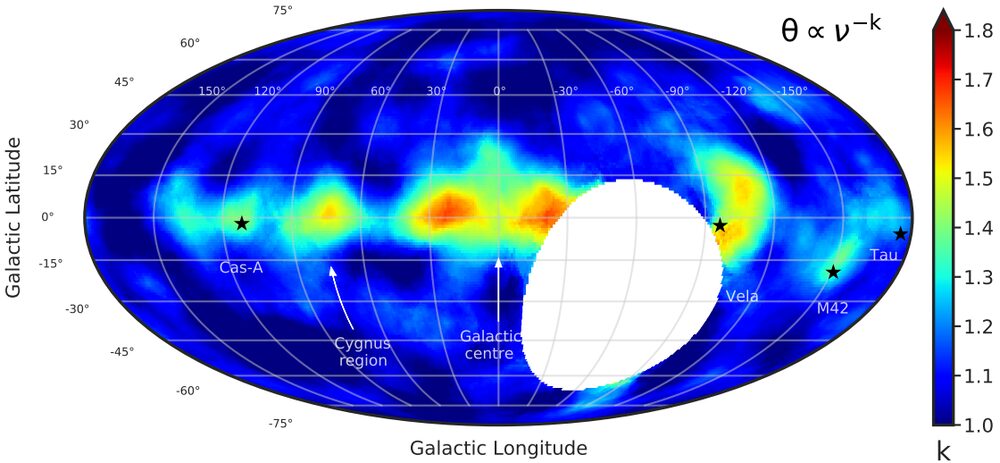
We used archival very long baseline interferometry (VLBI) data of active galactic nuclei (AGN) observed from 1.4 to 86 GHz to measure the angular size of VLBI radio cores in 8959 AGNs. We analysed their sky distributions, frequency dependencies, and created the most densely sampled and complete to date distribution map of large-scale scattering properties of the interstellar medium in our Galaxy. Significant angular broadening of the measured AGN core sizes is detected for the sources seen through the Galactic plane, and this effect is especially strong at low frequencies (e.g. at 2 GHz). The scattering screens containing electron density fluctuations of hot plasma are mainly concentrated in the Galactic plane and manifest clumpy distribution. The region of the strongest scattering is the Galactic centre, where the Galactic bar and the compact radio source Sagittarius A* are located. We have also found the enhancement of scattering strength in regions of the Cygnus constellation, supernova remnants Taurus A, Vela, W78 and Cassiopeia A, and the Orion Nebula. Using multifrequency observational data of AGN core sizes, we separated the contribution of the intrinsic and scattered sizes to the measured angular diameter for 1411 sources. For the sources observed through the Galactic plane, the contribution of the scattered size component is systematically larger than for those seen outside the Galactic plane. The derived power-law scattering indices are found to be in good agreement with theoretical predictions for the diffractive-dominated scattering of radio emission in a hot plasma with Gaussian distribution of density inhomogeneities.

The science case and challenges of space-borne sub-millimeter interferometry
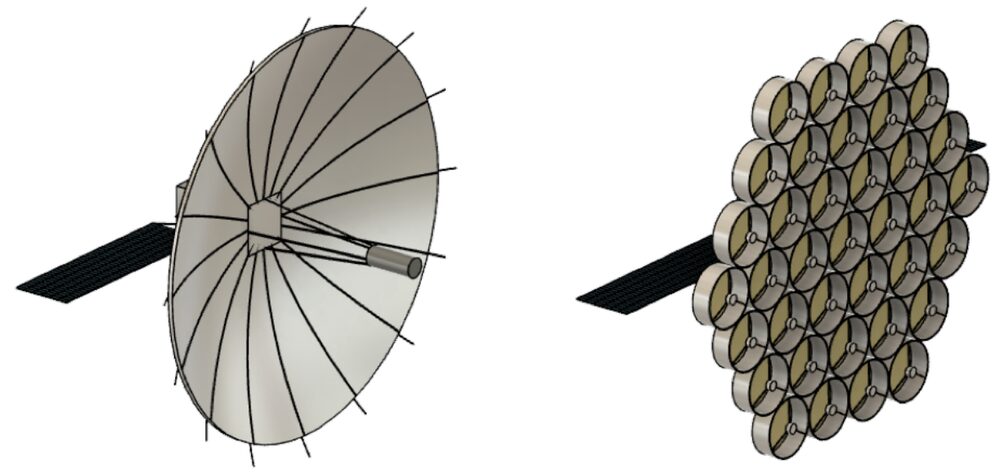
Ultra-high angular resolution in astronomy has always been an important vehicle for making fundamental discoveries. Recent results in direct imaging of the vicinity of the supermassive black hole in the nucleus of the radio galaxy M87 by the millimeter VLBI system Event Horizon Telescope and various pioneering results of the Space VLBI mission RadioAstron provided new momentum in high angular resolution astrophysics. In both mentioned cases, the angular resolution reached the values of about 10-20 microarcseconds (0.05-0.1 nanoradian). Further developments towards at least an order of magnitude "sharper" values, at the level of 1 microarcsecond are dictated by the needs of advanced astrophysical studies. The paper emphasis that these higher values can only be achieved by placing millimeter and submillimeter wavelength interferometric systems in space. A concept of such the system, called Terahertz Exploration and Zooming-in for Astrophysics, has been proposed in the framework of the ESA Call for White Papers for the Voyage 2050 long term plan in 2019. In the current paper we present new science objectives for such the concept based on recent results in studies of active galactic nuclei and supermassive black holes. We also discuss several approaches for addressing technological challenges of creating a millimeter/sub-millimeter wavelength interferometric system in space. In particular, we consider a novel configuration of a space-borne millimeter/sub-millimeter antenna which might resolve several bottlenecks in creating large precise mechanical structures. The paper also presents an overview of prospective space-qualified technologies of low-noise analogue front-end instrumentation for millimeter/sub-millimeter telescopes. Data handling and processing instrumentation is another key technological component of a sub-millimeter Space VLBI system. Requirements and possible implementation options for this instrumentation are described as an extrapolation of the current state-of-the-art Earth-based VLBI data transport and processing instrumentation. The paper also briefly discusses approaches to the interferometric baseline state vector determination and synchronisation and heterodyning system. The technology-oriented sections of the paper do not aim at presenting a complete set of technological solutions for sub-millimeter (terahertz) space-borne interferometers. Rather, in combination with the original ESA Voyage 2050 White Paper, it sharpens the case for the next generation microarcsecond-level imaging instruments and provides starting points for further in-depth technology trade-off studies.

The radio blazar TXS 1749-101 coincident with two high-energy neutrinos: IceCube alerts 181023A and the recent 220425A
The arrival direction of the recently detected high-energy (~604 TeV) neutrino, IceCube GOLD alert 220425A (GCN #31944), coincides with the blazar TXS 1749-101.
Direction of Parsec-scale Jets for 9220 Active Galactic Nuclei
The direction of parsec-scale jets in active galactic nuclei (AGNs) is essential information for many astrophysical and astrometric studies, including linear polarization and magnetic field structure, frequency-dependent synchrotron opacity, proper motion, and reference-frame alignment. We developed a rigorous, simple, and completely automated method to measure the directions from calibrated interferometric visibility data at frequencies ranging from 1.4 to 86 GHz. We publish the results for 9220 AGNs with the typical accuracy below 10°. An internal check of the method comparing the directions between different observing frequencies as well as with previous publications verifies the robustness of the measured values.

FRB 121102: Drastic changes in the burst polarization contrasts with the stability of the persistent emission
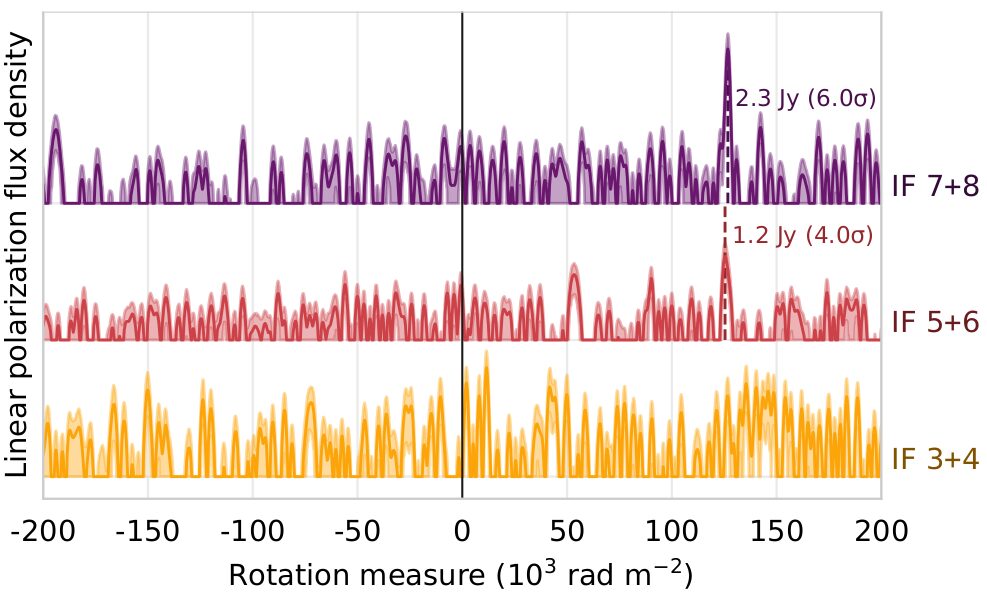
We study milliarcsecond-scale properties of the persistent radio counterpart to FRB 121102 and investigate the spectro-polarimetric properties of a bright burst. For the former, we use European VLBI Network (EVN) observations in 2017 at 1.7 and 4.8 GHz. For the latter, we reanalyse the 1.7-GHz data from the 100-m Effelseberg telescope taken in 2016. These observations predate other polarimetric studies of FRB 121102, and yield the highest burst Faraday rotation measure (RM) to date, RM = 1.27 · 105 rad m-2, consistent with the decreasing RM trend. The fractional polarization of the burst emission is 15 per cent at 1.7 GHz. This can be reconciled with the high-fractional polarization at higher frequencies if the Faraday width of the burst environment is 150 rad m-2 - a bare 0.1 per cent of the total Faraday rotation. The width may originate from minor non-uniformities in the Faraday screen, or from effects in the emitting region itself. The upper limit on the persistent source size is 1 pc, barely consistent with a young supernova (SN) scenario. The flux variability limit of < 10 per cent is not in favour of the young SN scenario, and challenges other interpretations as well. The fractional polarization of the faint persistent source is constrained at < 25 per cent at 4.8 GHz ruling out a common origin with the highly polarized individual bursts.

Search for neutrino counterpart to the blazar PKS0735+178 potentially associated with IceCube-211208A and Baikal-GVD-211208A with the KM3NeT neutrino detectors.
Using data from the KM3NeT neutrino detectors, we have performed a follow-up analysis of the potential correlation between one track event IceCube-211208A (GCN #31191 > ) and a flare of the blazar PKS0735+178.
The flaring radio-bright blazar PKS 0215+015 coincident with the high energy neutrino alert IceCube-220225A
The recent BRONZE neutrino alert IceCube-220225, GCN #31650, with an energy of 154 TeV is suggested to be associated with the radio-bright blazar PKS 0215+015 following the predictions of Plavin et al. (2020) analysis.
The radio-bright blazar PKS 1741-03 coincident with the high energy neutrino alert IceCube-220205B
The recent GOLD neutrino alert IceCube-220205, GCN #31554, with an energy above 200 TeV is suggested to be associated with the blazar PKS 1741-03. We note that this is one of the brightest blazars on the radio sky and is one of only four blazars singled out by Plavin et al. (2020) as the most probable high energy neutrino sources.
Blazar 0250-001 with bright VLBI-compact core is a probable neutrino candidate source for IceCube-211116A
We have recently shown that VLBI-selected radio-bright AGN are highly probable neutrino associations (Plavin et al., 2020, 2021) with neutrinos being generated within their central parsec-scale region.
Radio blazar 1801+253 is associated with IceCube-210811A and flares immediately after the neutrino event
We have recently shown that VLBI-selected radio-bright AGN are highly probable neutrino associations (Plavin et al., 2020, 2021) with neutrinos being generated within their central parsec-scale region.
Directional Association of TeV to PeV Astrophysical Neutrinos with Radio Blazars
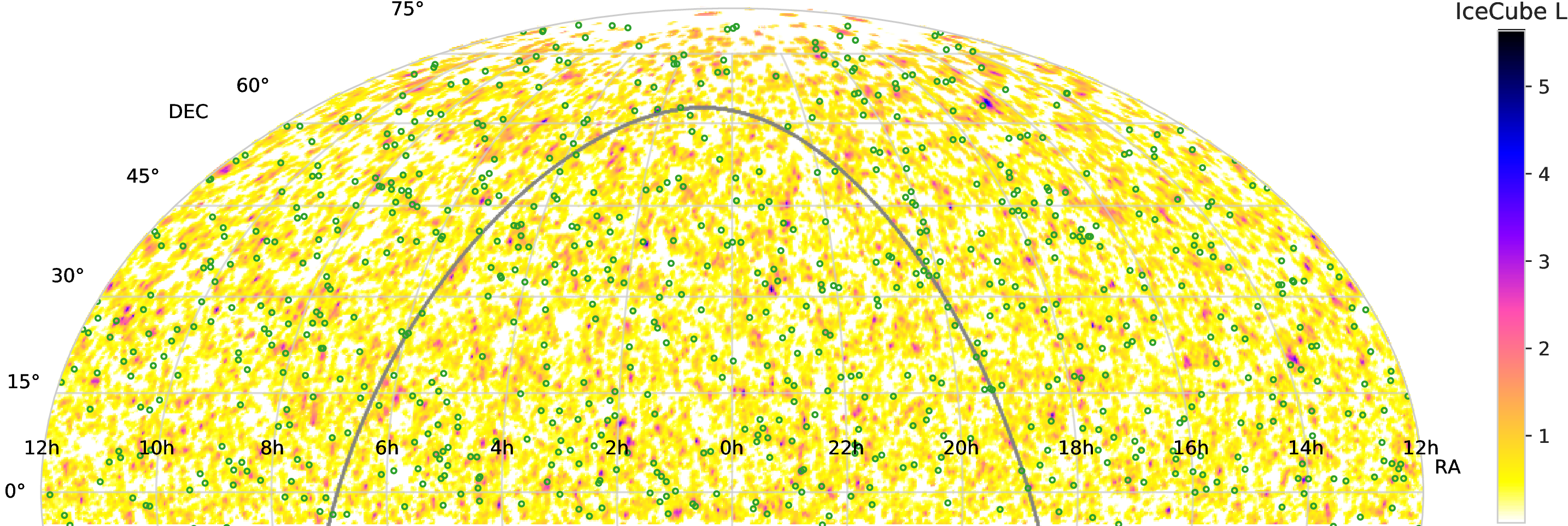
Recently we have shown that high-energy neutrinos above 200 TeV detected by IceCube are produced within several parsecs in the central regions of radio-bright blazars, that is active galactic nuclei with jets pointing toward us. To independently test this result and extend the analysis to a wider energy range, we use public data for all neutrino energies from seven years of IceCube observations. The IceCube point-source likelihood map is analyzed against the positions of blazars from a statistically complete sample selected according to their compact radio flux density. The latter analysis delivers a 3.0σ significance, with the combined post-trial significance of both studies being 4.1σ. The correlation is driven by a large number of blazars. Together with fainter but physically similar sources not included in the sample, they may explain the entire IceCube astrophysical neutrino flux as derived from muon-track analyses. The neutrinos can be produced in interactions of relativistic protons with X-ray self-Compton photons in parsec-scale blazar jets.
Blazars J0201-1132 and J0206-1150 with bright VLBI-compact cores are probable neutrino source candidates for IceCube-201130A
We have recently shown that VLBI-selected radio-bright blazars are highly probable neutrino sources (Plavin et al. 2020, ApJ, 894, 101 and Plavin et al. 2020, arXiv:2009.08914).
A bias in VLBI measurements of the core shift effect in AGN jets
The Blandford and Königl model of active galactic nuclei (AGN) jets predicts that the position of the apparent opaque jet base - the core - changes with frequency. This effect is observed with radio interferometry and is widely used to infer parameters and structure of the innermost jet regions. The position of the radio core is typically estimated by fitting a Gaussian template to the interferometric visibilities. This results in a model approximation error, i.e. a bias that can be detected and evaluated through simulations of observations with a realistic jet model. To assess the bias, we construct an artificial sample of sources based on the AGN jet model evaluated on a grid of the parameters derived from a real VLBI flux-density-limited sample and create simulated VLBI data sets at 2.3, 8.1, and 15.4 GHz. We found that the core position shifts from the true jet apex are generally overestimated. The bias is typically comparable to the core shift random error and can reach a factor of 2 for jets with large apparent opening angles. This observational bias depends mostly on the ratio between the true core shift and the image resolution. This implies that the magnetic field, the core radial distance, and the jet speed inferred from the core shift measurements are overestimated. We present a method to account for the bias.

A transition from parabolic to conical shape as a common effect in nearby AGN jets
Observational studies of collimation in jets in active galactic nuclei (AGN) are a key to understanding their formation and acceleration processes. We have performed an automated search for jet shape transitions in a sample of 367 AGN using VLBA data at 15 and 1.4 GHz. This search has found 10 out of 29 nearby jets at redshifts z < 0.07 with a transition from a parabolic to conical shape, while the full analysed sample is dominated by distant AGN with a typical z ≍ 1. The ten AGN are UGC 00773, NGC 1052, 3C 111, 3C 120, TXS 0815-094, Mrk 180, PKS 1514+00, NGC 6251, 3C 371, and BL Lac. We conclude that the geometry transition may be a common effect in AGN jets. It can be observed only when sufficient linear resolution is obtained. Supplementing these results with previously reported shape breaks in the nearby AGN 1H 0323+342 and M87, we estimate that the break occurs at 105-106 gravitational radii from the nucleus. We suggest that the jet shape transition happens when the bulk plasma kinetic energy flux becomes equal to the Poynting energy flux, while the ambient medium pressure is assumed to be governed by Bondi accretion. In general, the break point may not coincide with the Bondi radius. The observational data support our model predictions on the jet acceleration and properties of the break point.


Observational Evidence for the Origin of High-energy Neutrinos in Parsec-scale Nuclei of Radio-bright Active Galaxies
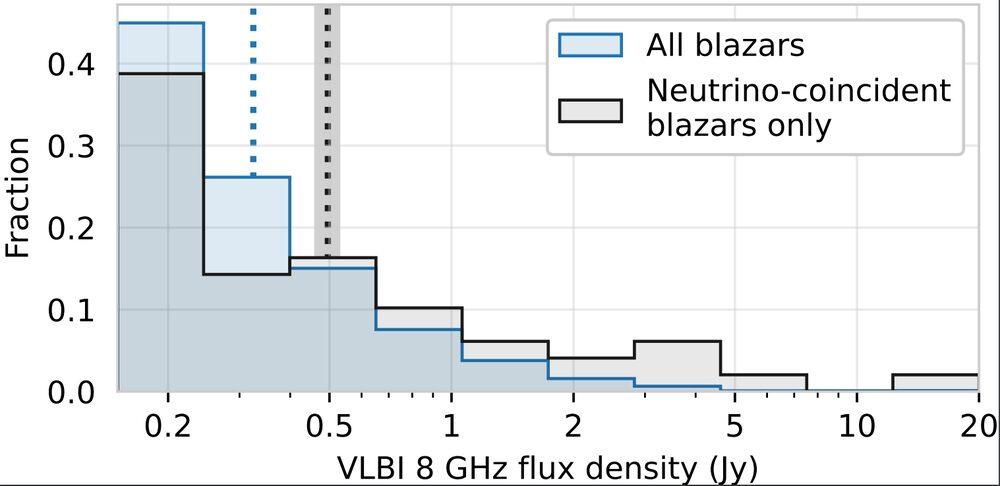
Observational information on high-energy astrophysical neutrinos is being continuously collected by the IceCube observatory. However, the sources of the neutrinos are still unknown. In this study, we use radio very long baseline interferometry (VLBI) data for a complete VLBI flux density-limited sample of active galactic nuclei (AGNs). We address the problem of the origin of astrophysical neutrinos with energies above 200 TeV in a statistical manner. It is found that AGNs positionally associated with IceCube events have typically stronger parsec-scale cores than the rest of the sample. The posttrial probability of a chance coincidence is 0.2%. We select the four strongest AGNs as highly probable associations: 3C 279, NRAO 530, PKS 1741-038, and OR 103. Moreover, we find an increase of radio emission at frequencies above 10 GHz around neutrino arrival times for several other VLBI-selected AGNs on the basis of RATAN-600 monitoring. The most pronounced example of such behavior is PKS 1502+106. We conclude that AGNs with bright Doppler-boosted jets constitute an important population of neutrino sources. High-energy neutrinos are produced in their central parsec-scale regions, probably in proton-photon interactions at or around the accretion disk. Radio-bright AGNs that are likely associated with neutrinos have very diverse γ-ray properties, suggesting that γ-rays and neutrinos may be produced in different regions of AGNs and not directly related. A small viewing angle of the jet-disk axis is, however, required to detect either of them.

Optical polarization properties of AGNs with significant VLBI-Gaia offsets
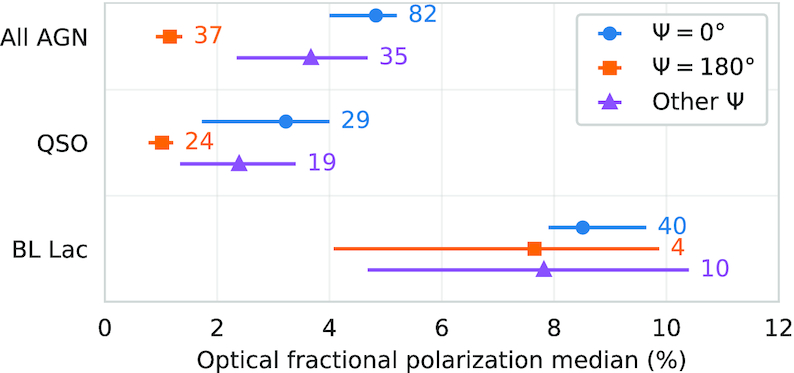
Significant positional offsets of the value from 1 mas to more than 10 mas were found previously between radio (VLBI) and optical (Gaia) positions of active galactic nuclei (AGNs). They happen preferentially parallel to the parsec-scale jet direction. AGNs with VLBI-to-Gaia offsets pointed downstream the jet are found to have favourably higher optical polarization, as expected if extended optical jets dominate in the emission and shift the Gaia centroid away from the physical nucleus of the source. Upstream offsets with the suggested domination of accretion discs manifest themselves through the observed low optical polarization. Direction of linear optical polarization is confirmed to preferentially align with parsec-scale jets in AGNs with dominant jets consistent with a toroidal magnetic field structure. Our findings support the disc-jet interpretation of the observed positional offsets. These results call on an intensification of AGN optical polarization monitoring programs in order to collect precious observational data. Taken together with the continued VLBI and Gaia observations, they will allow researchers to reconstruct detailed models of the disc-jet system in AGNs on parsec scales.

The RATAN-600 2-22 GHz continuum spectrum of the neutrino association quasar TXS 1100+122 is slightly rising
In ATel 13397 we argued that the quasar TXS 1100+122 is a highly probable neutrino association for the IceCube-200109A event due to its compact and bright core at parsec scales (8 GHz VLBI image) following conclusions by Plavin et al. (arXiv:2001.00930).
Flat spectrum radio quasar TXS 1100+122 has a bright VLBI-compact core - as expected for neutrino candidate sources
We have recently shown that VLBI-selected radio-bright AGN are highly probable neutrino associations (Plavin et al., arXiv:2001.00930) with neutrino being generated within their central parsec-scale region.
Inferring the jet parameters of active galactic nuclei using Bayesian analysis of VLBI data with a non-uniform jet model
The physical parameters of the jets of active galactic nuclei observed with Very Long Baseline Interferometry (VLBI) are usually inferred from core-shift measurements or from the flux and size measured at the peak frequency of the synchrotron spectrum. Both methods are preceded by modelling the observed VLBI jet structure with simple Gaussian templates. Here we infer the jet parameters using an inhomogeneous jet model directly, bypassing the modelling of the source structure with a Gaussian template or image deconvolution. We apply Bayesian analysis to multifrequency VLBA observations of radio galaxy NGC 315 and find that its parsec-scale jet is well described by an inhomogeneous conical model. Our results favour an electron-positron jet. We also detect a component as a part of a counter jet. Its position implies the presence of an external absorber with a steep density gradient close (r = 0.1 pc) to the central engine.

Significant core shift variability in parsec-scale jets of active galactic nuclei
The apparent position of jet base (core) in radio-loud active galactic nuclei changes with frequency because of synchrotron self-absorption. Studying this `core shift' effect enables us to reconstruct properties of the jet regions close to the central engine. We report here results from core shift measurements in AGNs observed with global VLBI at 2 and 8 GHz at epochs from 1994 to 2016. Our sample contains 40 objects observed at least 10 times during that period. The core shift is determined using a new automatic procedure introduced to minimize possible biases. The resulting multiple epoch measurements of the core position are employed for examining temporal variability of the core shift. We argue that the core shift variability is a common phenomenon, as established for 33 of 40 AGNs we study. Our analysis shows that the typical offsets between the core positions at 2 and 8 GHz are about 0.5 mas and they vary in time. Typical variability of the individual core positions is about 0.3 mas. The measurements show a strong dependence between the core position and its flux density, suggesting that changes in both are likely related to the nuclear flares injecting denser plasma into the flow. We determine that density of emitting relativistic particles significantly increases during these flares, while relative magnetic field changes less and in the opposite direction.
Dissecting the AGN Disk-Jet System with Joint VLBI-Gaia Analysis
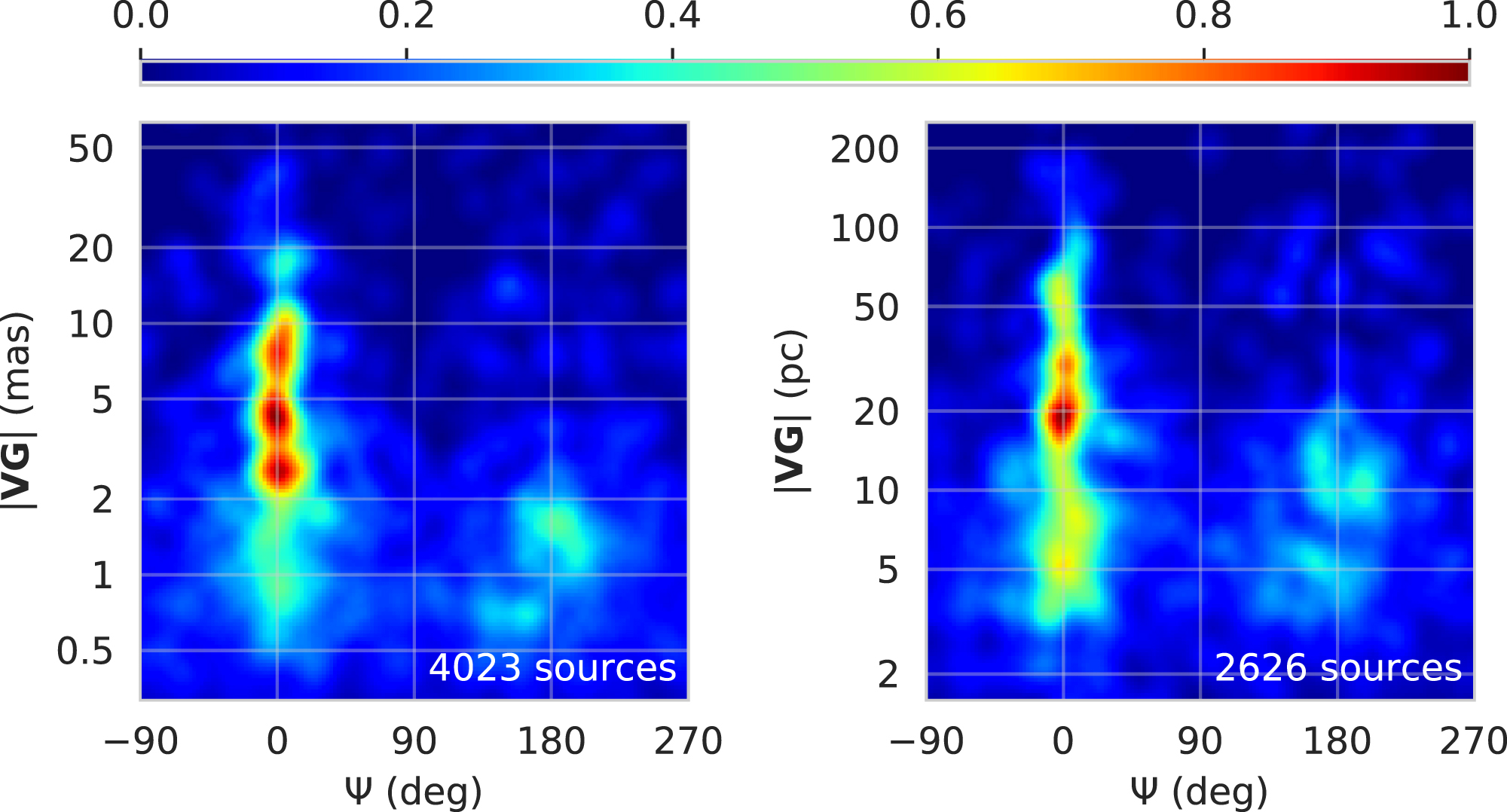
We analyze differences in positions of active galactic nuclei (AGNs) between Gaia data release 2 and very long baseline interferometry (VLBI) and compare the significant VLBI-to-Gaia offsets in more than 1000 objects with their jet directions. Remarkably at least three-fourths of the significant offsets are confirmed to occur downstream or upstream of the jet representing a genuine astrophysical effect. Introducing redshift and Gaia color into analysis can help distinguish between the contribution of the host galaxy, jet, and accretion disk emission. We find that strong optical jet emission at least 20-50 pc long is required to explain the Gaia positions located downstream from VLBI ones. Offsets in the upstream direction of up to 2 mas are at least partly due to the dominant impact of the accretion disk on the Gaia coordinates and by the effects of the parsec-scale radio jet. The host galaxy was found not to play an important role in the detected offsets. BL Lacertae object and Seyfert 2 galaxies are observationally confirmed to have a relatively weak disk and consequently downstream offsets. The disk emission drives upstream offsets in a significant fraction of quasars and Seyfert 1 galaxies when it dominates over the jet in the optical band. The observed behavior of the different AGN classes is consistent with the unified scheme assuming varying contribution of the obscuring dusty torus and jet beaming.
A quantitative analysis of systematic differences in the positions and proper motions of Gaia DR2 with respect to VLBI
We have analysed the differences in positions of 9081 matched sources between the Gaia Data Release 2 (DR2) and very long baseline interferometry (VLBI) catalogues. The median position uncertainty of matched sources in the VLBI catalogue is a factor of two larger than the median position uncertainty in Gaia DR2. There are 9 per cent matched sources with statistically significant offsets between both catalogues. We found that the reported positional errors should be rescaled by a factor of 1.3 for VLBI and 1.06 for Gaia and, in addition, the Gaia errors should be multiplied by the square root of chi squared per degree of freedom in order to best fit the normalized position differences to the Rayleigh distribution. We have established that the major contributor to statistically significant position offsets is the presence of optical jets. Among the sources for which the jet direction was determined, the position offsets are parallel to the jet directions for 62 per cent of the outliers. Among the matched sources with significant proper motion, the fraction of objects with proper motion directions parallel to jets is a factor of three greater than on average. Such sources have systematically higher chi squared per degree of freedom. We explain these proper motions as a manifestation of the source position jitter caused by flares, which we predicted earlier. Therefore, the assumption that quasars are fixed points, and thus that differential proper motions determined with respect to quasar photocentres can be regarded as absolute proper motions, should be treated with great caution.

Frequency-Dependent Core Shifts in Ultracompact Quasars
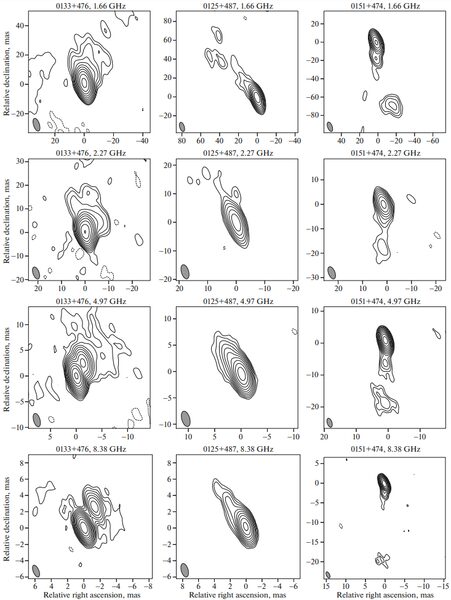
Results of a pilot project with the participation of the "Kvazar-KVO" radio interferometry array in observations carried out with the European VLBI Network are presented. The aim of the project was to conduct and analyze multi-frequency (1.7, 2.3, 5.0, 8.4 GHz) observations of the parsec-scale jets of 24 active galactic nuclei. Three observing sessions were successfully carried out in October 2008. Maps of the radio intensity distributions have been constructed in all four frequencies using phase referencing. A method for measuring the frequency-dependent shift of the position of the VLBI core by applying relative astrometry to observations of close triplets of radio sources has been developed. The fundamental possibility of detecting core shifts in ultra-compact sources for which traditional methods based on the achromatic positions of optically thin regions of the jet are not suitable is demonstrated. The conditions for successful measurement of this shift are discussed; these are determined by the closeness of the calibrator used, the effective resolution of the system, the quality of the filling of the uv plane, the relative orientations of the jets in the triplets, and the brightnesses of the sources.

VLBI-Gaia offsets favor parsec-scale jet direction in active galactic nuclei
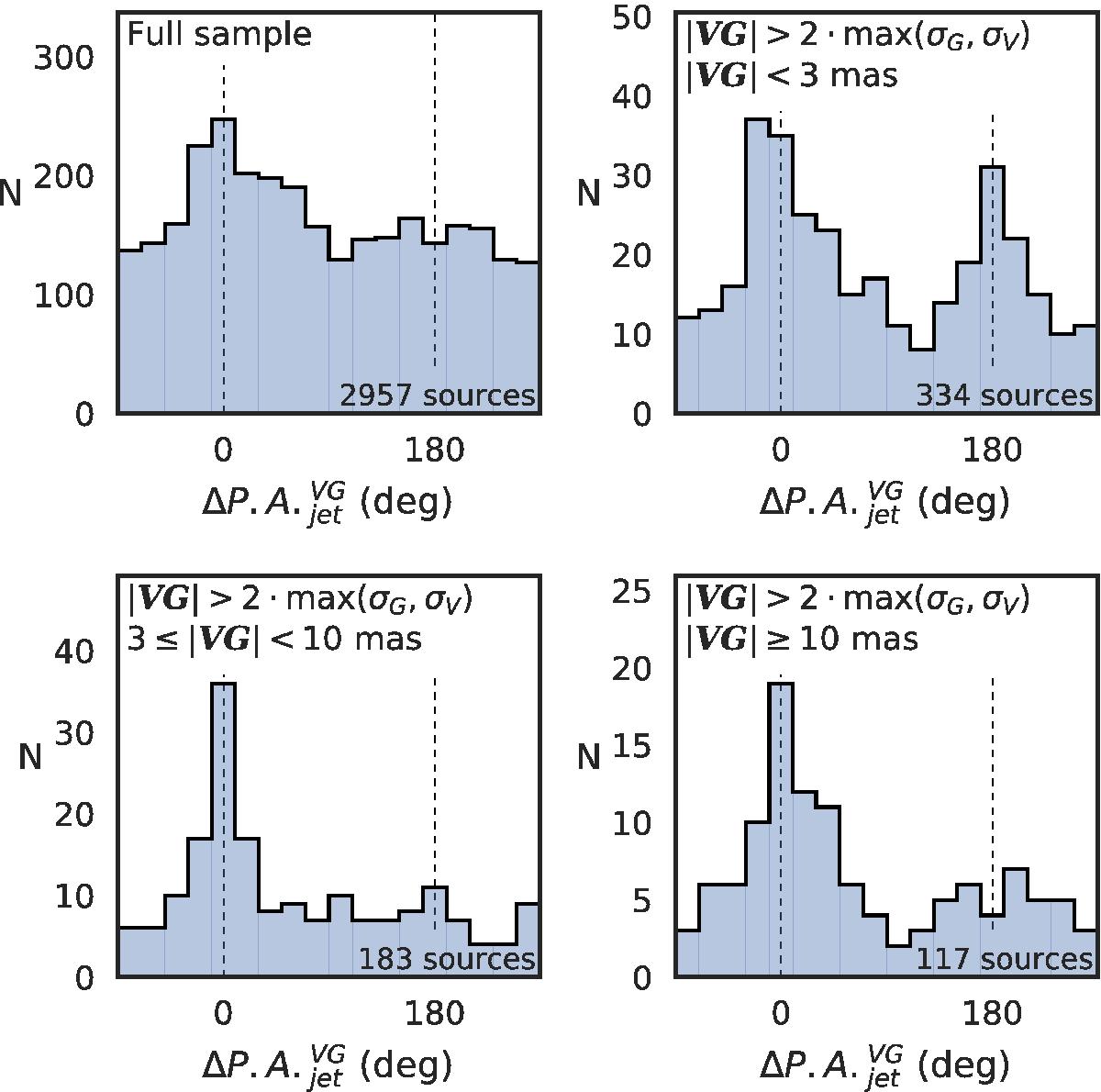
Context. The data release 1 (DR1) of milliarcsecond-scale accurate optical positions of stars and galaxies was recently published by the space mission Gaia. Aims: We study the offsets of highly accurate absolute radio (very long baseline interferometry, VLBI) and optical positions of active galactic nuclei (AGN) to see whether or not a signature of wavelength-dependent parsec-scale structure can be seen. Methods: We analyzed VLBI and Gaia positions and determined the direction of jets in 2957 AGNs from their VLBI images. Results: We find that there is a statistically significant excess of sources with VLBI-to-Gaia position offset in directions along and opposite to the jet. Offsets along the jet vary from 0 to tens of mas. Offsets in the opposite direction do not exceed 3 mas. Conclusions: The presense of strong, extended parsec-scale optical jet structures in many AGNs is required to explain all observed VLBI-Gaia offsets along the jet direction. The offsets in the opposite direction shorter than 1 mas can be explained either by a non-point-like VLBI jet structure or a "core-shift" effect due to synchrotron opacity.